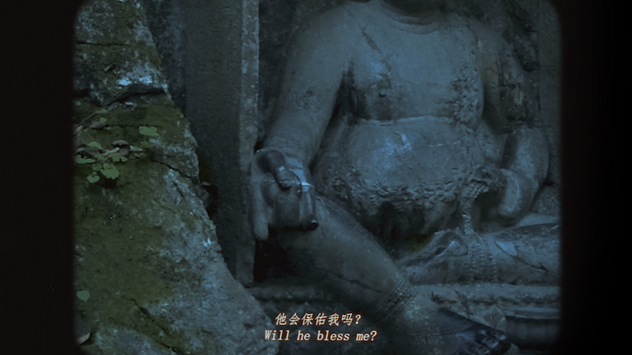
The Tunnels Where We Incarnated, 2026
colour film, 39mins
The Tunnels Where We Incarnated unfolds from a gateway shaped by birth, interruption, and spiritual return. Combining documentary footage with AI-generated imagery, the film imagines a joint perspective formed between my unborn brother and myself as the born sister: an embodied consciousness situated between arrival and absence, that encounters the world before identity settles into pronounced and rigid hierarchies. Dreams, religious rituals, and memories merge into a single field where living and unlived lives entangle, and the structure of the world is redefined.
Psychological research suggests that perceptual attention often precedes social categorisation. Before objects and beings are assigned value within cultural or institutional systems, they are first registered through their innate presence (inherent information) rather than their context, history, or relationship with other things (extrinsic information). As we develop to adaptively coordinate social systems, however, we grow to automatically classify every presence into categories by its status, utility, or prestige. Perceptions are no longer mere observation, but pushed toward instrumental evaluation based on goals and incentives. Attention becomes biased toward things being labelled valuable or inferior.
The film returns attention to the earlier stage of perception. Joined by a consciousness that never fully entered the world, our shared vantage suspends the hierarchies through which human societies rank and attribute differential values, allowing disparate presences to appear within the same perceptual field.
The work traces two pregnancies carried by my mother during the years of China’s one-child policy, both were preceded by vivid and symbolic conception dreams (胎梦) as important omens and premonitions arriving before decisive moments. Before losing her first child, she dreamt of a massive one-eyed stone dragon chasing her relentlessly. The next day, a car accident revealed her conception through an X-ray examination. Fearing the radiation might have harmed the foetus and the subsequent suffering, she chose to terminate the pregnancy. The decision carried enduring grief and guilt, marking the ending of her first child before he could arrive (she believed that he was a boy as dragon symbolises male and phoenix as female in traditional Chinese culture).
Years later, already a mother of one daughter, she found herself pregnant with me again under the pressure of the one-child policy. While hiding the pregnancy from state authorities, she dreamt again of chickens being scalded alive, with one body stripped off feather yet still escaping. The dream carried both fear and forewarning, echoing the precarious coexistence of multiple lives within a single body. The following morning, she decided to step out of the house to take a walk after months of hiding indoors, only shortly before officials arrived searching for her to force an abortion.
Though my birth was seen as a blessing and destined, the tensions that followed between my mother and me as I grew up demanded explanation. As a devout Buddhist, she sought guidance from a Buddhist Upāsikā, who spoke of consciousness remaining beyond bodily death through karmic and unfinished relations. Through this spiritual interpretation, my mother came to believe that the unborn first child had attached himself to me. My difficult temperament and our persistent conflicts were read as evidence of this shared inhabitation: a life interrupted seeking resolution through another body.
Positioned between an undeparted spirit awaiting exorcism and a daughter defying familial expectation, a shared presence emerges at the edge of social legibility. From the marginal vantage, the world is not organised by status, utility, or prestige, but encountered as a constellation of coexisting presences. The notion of inferior and superior is dismantled as we travel through the tunnels, the distinction loosens between human and animal, sacred relic and discarded debris, sentient and inanimate bodies. Hierarchies that ordinarily structure perception recede, each presence is attended to with the same measured regard.
The camera maintains a measured distance from the filmed subjects, following, echoing, and occasionally mimicking their movements. Operating like an invisible frequency, it moves through tunnels, loess caves, burial corridors, grottoes, and other subterranean passages resembling womb-like cambers and transitional corridors between the born and unborn. From this displaced perspective, seemingly unrelated moments begin to resonate: a man humming symphonises with the bubbling rhythm of a stream, goats driven through a livestock market echoes a slowly moving herd in the wild open, ground maintenance workers sweeping temple courtyards or mowing lawns in parks repeat similar gestures across distant locations. Transitions between scenes emerge through synchronous perceived frequencies of sound, motion, and rhythm, rather than narrative causality.
Following the travelling gaze, the film reveals that value is not inherent in entities, but is continually reassigned by shifting regimes of attention, desire, economy, and policy. Population policies alternately encourage births or enforce their disappearance, a life could be longed for or terminated as medical waste. Livestock shifts between commodity and living presence as they move between the market and the pasture in Xinjiang. Several ancient sites in Shanxi have become spectacles with a surge of tourism following the trends sparked by the video game “Black Myth: Wukong”, while another village in the same province (坟上村), rich in architectural heritage remain largely deserted, with its marginalised senior population and absence of digital representation. Devotion unfolds in a temple known for its miraculous powers in response to prayers (灵隐寺), as the overflowing intense burners, repetitive gestures of reverence, and accumulating offerings beneath statues, through shared desires and beliefs.
When values are reattributed and attention converged, the material remains are left behind as the residue of desire and passed moments. Ruins and demolished architecture preserve the previous aspiration of space and shelter, where time seems suspended. Other traces accumulate through repeated social gestures: offerings left beneath statues, incense burned in dense succession, photographs taken in collective imitation. Over time, these mass production leave their own excess as ash, discarded objects, and forgotten images.
In the film’s final movement, an inverted torchlight appears as a drifting black point before slowly dissolving into darkness. The image marks the ritual that separated my brother’s presence from my body. Yet the departure feels less like an expulsion than a decision; the consciousness that once shared my perception withdraws. Not every life seeks completion through incarnation.